
Search

jeudi 10 décembre 2009

George Soros


Founder and Chairman
Open Society Institute

A global financier and philanthropist, George Soros is the founder and chairman of a network of foundations that promote, among other things, the creation of open, democratic societies based upon the rule of law, market economies, transparent and accountable governance, freedom of the press, and respect for human rights.

Soros was born in Budapest, Hungary, in 1930. His father was taken prisoner during World War I and eventually fled from captivity in Russia to reunite with his family in Budapest. Soros was thirteen years old when Hitler's Wehrmacht seized Hungary and began deporting the country's Jews to extermination camps. In 1946, as the Soviet Union was taking control of the country, Soros attended a conference in the West and defected. He emigrated in 1947 to England, supported himself by working as a railroad porter and a restaurant waiter, graduated in 1952 from the London School of Economics, and obtained an entry-level position with an investment bank.
Philosophy

At the London School of Economics, Soros became acquainted with the work of the philosopher Karl Popper, whose ideas on open society had a profound influence on his intellectual development. Specifically, Soros's experience of Nazi and Communist rule attracted him to Popper’s critique of totalitarianism, The Open Society and Its Enemies, in which he maintained that societies can only flourish when they allow democratic governance, freedom of expression, a diverse range of opinion, and respect for individual rights.
Finance

In 1956, Soros immigrated to the United States. He worked as a trader and analyst until 1963. During this period, Soros adapted Popper's ideas to develop his own "theory of reflexivity," a set of ideas that seeks to explain the relationship between thought and reality, which he used to predict, among other things, the emergence of financial bubbles. Soros began to apply his theory to investing and concluded that he had more talent for trading than for philosophy. In 1967 he helped establish an offshore investment fund; and in 1973 he set up a private investment firm that eventually evolved into the Quantum Fund, one of the first hedge funds, through which he accumulated a vast fortune.
Philanthropy

As his financial success mounted, Soros applied his wealth to help foster the development of open societies. In 1979, Soros provided funds to help black students attend the University of Cape Town in apartheid South Africa. Soon he created a foundation in Hungary to support culture and education and the country’s transition to democracy. (One of his projects imported photocopy machines that allowed citizens and activists in Hungary to spread information and publish censored materials.) Soros also distributed funds to the underground Solidarity movement in Poland, Charter 77 in Czechoslovakia, and the Soviet physicist-dissident Andrei Sakharov. In 1982, Soros named his philanthropic organization the Open Society Fund, in honor of Karl Popper, and began granting scholarships to students from Eastern Europe. Bolstered by the success of these projects, Soros created more programs to assist the free flow of information. He supported educational radio programs in Mongolia and later contributed $100 million to provide Internet access to every regional university in Russia.

The magnitude and geographical scope of his philanthropic commitments, coupled with the core principle of fostering open societies, has allowed Soros to transcend the limitations of many national governments and international institutions. During the 1980s, Soros financed a trip by young economists at a reform-minded think tank in China to a business university in Budapest; he also established a grantmaking foundation in China to foster civil society and transparency. In 1991, he helped found the Central European University, a graduate institution in Budapest that focuses on social and political development. Soros spent $50 million to help the citizens of Sarajevo endure the city’s siege during the Bosnian war, funding among other projects a water-filtration plant that allowed residents to avoid having to draw water from distribution points targeted by Serb snipers. Most recently, he has provided $50 million to support the Millennium Villages initiative, which seeks to lift some of the least developed villages in Africa out of poverty.

In 1993, Soros created the Open Society Institute, which supports the Soros foundations working to develop democratic institutions throughout Central and Eastern Europe and the former Soviet Union. His network of philanthropic organizations dedicated to building open societies has expanded to include more than 60 countries in the Middle East, Central Asia, Africa, and Latin America. Despite the breadth of his endeavors, Soros is personally involved in planning and implementing many of the foundation network’s projects. His visionary efforts have produced a remarkable record of successful philanthropy, including efforts to free developmentally challenged people from life-long confinement in state institutions, to provide palliative care to the dying, to win release for prisoners held without legal grounds in penitentiaries in Nigeria, to halt the spread of tuberculosis and HIV/AIDS, to create debate societies, to promote freedom of the press, and to help resource-rich countries establish mechanisms to manage their revenues in a way that will promote economic growth and good governance rather than poverty and instability.

In 2003, Soros said that removing President George W. Bush from office was one of his main priorities. During the 2004 campaign, he donated significant funds to various groups dedicated to defeating the president.
Publications

In 2006, Mr. Soros published The Age of Fallibility: Consequences of The War on Terror (Public Affairs, 2006). His previous books include The Bubble of American Supremacy (2005); George Soros on Globalization (2002); Open Society: Reforming Global Capitalism (2000); The Crisis of Global Capitalism: Open Society Endangered (1998); Soros on Soros: Staying Ahead of the Curve (1995); Underwriting Democracy (1991); Opening the Soviet System (1990); and The Alchemy of Finance (1987). His essays on politics, society, and economics appear frequently in major periodicals around the world.

Soros has received honorary degrees from the New School for Social Research, Oxford University, the Budapest University of Economics, and Yale University. In 1995, the University of Bologna awarded Soros its highest honor, the Laurea Honoris Causa, in recognition of his efforts to promote open societies throughout the world.

George Soros's political activities are wholly separate from the Open Society Institute. Read an official OSI statement on this subject.

For more information about George Soros's activities that are separate from the Open Society Institute, visit www.georgesoros.com.
back to the top of the page

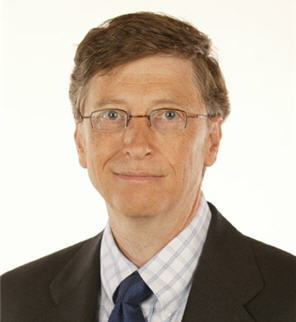
William (Bill) H. Gates


Is chairman of Microsoft Corporation, the worldwide leader in software, services and solutions that help people and businesses realize their full potential. Microsoft had revenues of US$51.12 billion for the fiscal year ending June 2007, and employs more than 78,000 people in 105 countries and regions.

On June 15, 2006, Microsoft announced that effective July 2008 Gates will transition out of a day-to-day role in the company to spend more time on his global health and education work at the Bill & Melinda Gates Foundation. After July 2008 Gates will continue to serve as Microsoft’s chairman and an advisor on key development projects. The two-year transition process is to ensure that there is a smooth and orderly transfer of Gates’ daily responsibilities. Effective June 2006, Ray Ozzie has assumed Gates’ previous title as chief software architect and is working side by side with Gates on all technical architecture and product oversight responsibilities at Microsoft. Craig Mundie has assumed the new title of chief research and strategy officer at Microsoft and is working closely with Gates to assume his responsibility for the company’s research and incubation efforts.

Born on Oct. 28, 1955, Gates grew up in Seattle with his two sisters. Their father, William H. Gates II, is a Seattle attorney. Their late mother, Mary Gates, was a schoolteacher, University of Washington regent, and chairwoman of United Way International.

Gates attended public elementary school and the private Lakeside School. There, he discovered his interest in software and began programming computers at age 13.

In 1973, Gates entered Harvard University as a freshman, where he lived down the hall from Steve Ballmer, now Microsoft's chief executive officer. While at Harvard, Gates developed a version of the programming language BASIC for the first microcomputer - the MITS Altair.

In his junior year, Gates left Harvard to devote his energies to Microsoft, a company he had begun in 1975 with his childhood friend Paul Allen. Guided by a belief that the computer would be a valuable tool on every office desktop and in every home, they began developing software for personal computers. Gates' foresight and his vision for personal computing have been central to the success of Microsoft and the software industry.

Under Gates' leadership, Microsoft's mission has been to continually advance and improve software technology, and to make it easier, more cost-effective and more enjoyable for people to use computers. The company is committed to a long-term view, reflected in its investment of approximately $7.1 billion on research and development in the 2007 fiscal year.

In 1999, Gates wrote Business @ the Speed of Thought, a book that shows how computer technology can solve business problems in fundamentally new ways. The book was published in 25 languages and is available in more than 60 countries. Business @ the Speed of Thought has received wide critical acclaim, and was listed on the best-seller lists of the New York Times, USA Today, the Wall Street Journal and Amazon.com. Gates' previous book, The Road Ahead, published in 1995, held the No. 1 spot on the New York Times' bestseller list for seven weeks.
Top row: Steve Wood (left), Bob Wallace, Jim Lane. Middle row: Bob O'Rear, Bob Greenberg, Marc McDonald, Gordon Letwin. Bottom row: Bill Gates, Andrea Lewis, Marla Wood, Paul Allen. December 7, 1978.

Gates has donated the proceeds of both books to non-profit organizations that support the use of technology in education and skills development.

In addition to his love of computers and software, Gates founded Corbis, which is developing one of the world's largest resources of visual information - a comprehensive digital archive of art and photography from public and private collections around the globe. He is also a member of the board of directors of Berkshire Hathaway Inc., which invests in companies engaged in diverse business activities.

Philanthropy is also important to Gates. He and his wife, Melinda, have endowed a foundation with more than $28.8 billion (as of January 2005) to support philanthropic initiatives in the areas of global health and learning, with the hope that in the 21st century, advances in these critical areas will be available for all people. The Bill and Melinda Gates Foundation has committed more than $3.6 billion to organizations working in global health; more than $2 billion to improve learning opportunities, including the Gates Library Initiative to bring computers, Internet Access and training to public libraries in low-income communities in the United States and Canada; more than $477 million to community projects in the Pacific Northwest; and more than $488 million to special projects and annual giving campaigns.

Gates was married on Jan. 1, 1994, to Melinda French Gates. They have three children. Gates is an avid reader, and enjoys playing golf and bridge.

vendredi 20 novembre 2009

Wyclef Jean


Lead Fugees rapper and sometime guitarist Wyclef Jean was the first member of his group to embark on a solo career, and he proved even more ambitious and eclectic on his own. As the Fugees hung in limbo, Wyclef also became hip-hop's unofficial multicultural conscience; a seemingly omnipresent activist, he assembled or participated in numerous high-profile charity benefit shows for a variety of causes, including aid for his native Haiti. The utopian one-world sensibility that fueled Wyclef's political consciousness also informed his recordings, which fused hip-hop with as many different styles of music as he could get his hands on (though, given his Caribbean roots, reggae was a particular favorite). In addition to his niche as hip-hop's foremost global citizen, Clef was also a noted producer and remixer who worked with an impressive array of pop, R&B, and hip-hop talent, including Whitney Houston, Santana, and Destiny's Child, among many others.

The son of a minister, Nelust Wyclef Jean was born in Croix-des-Bouquets, Haiti, on October 17, 1972. When he was nine, his family moved to the Marlborough projects in Brooklyn, NY; by his teenage years, Jean had moved to New Jersey, taken up the guitar, and begun studying jazz through his high school's music department. In 1987, he also joined a rap group with his cousin Prakazrel Michel (aka Pras) and Michel's high-school classmate Lauryn Hill. Initially calling themselves the Tranzlator Crew, they evolved into the Fugees, a name taken from slang for Haitian refugees. The trio signed with Ruffhouse Records in 1993 and released their debut album, Blunted on Reality, the following year; it attracted little notice, thanks to an inappropriate hardcore stance that the group wore like an ill-fitting suit. But the Fugees hit their stride on the follow-up, The Score, ignoring popular trends and crafting an eclectic, bohemian masterpiece that sounded like nothing else on the hip-hop landscape in 1996. Thanks to hit singles like "Fu-Gee-La" and "Killing Me Softly," The Score became a chart-topping phenomenon; in fact, with sales of over six million copies, it still ranks as one of the biggest-selling rap albums of all time.

Wyclef Jean was the first Fugee to declare plans for a solo project, setting to work soon after the group completed its supporting tours. Released in the summer of 1997, The Carnival (full title: Wyclef Jean Presents the Carnival Featuring the Refugee All-Stars) was even more musically ambitious than The Score. Its roster of guests included not only the remainder of the Fugees, but also Jean's siblings (who performed together in the duo Melky Sedeck), Cuban legend Celia Cruz, New Orleans funk mainstays the Neville Brothers, and Bob Marley's female backing vocalists the I Threes. The breadth of his ambition was further in evidence on the album's two hit singles; "We Trying to Stay Alive" recast the Bee Gees' signature disco tune as a ghetto empowerment anthem, and the Grammy-nominated "Gone Till November" was recorded with part of the New York Philharmonic Orchestra. Those two songs helped push The Carnival into a Top 20, triple-platinum showing, and most reviews were naturally quite positive.

In the wake of The Carnival, Wyclef stepped up his outside work for other artists; over the next few years, he collaborated as a producer, songwriter, and/or remixer with a typically diverse list of artists: Destiny's Child ("No No No"), Sublime, Simply Red, Whitney Houston (the title track of her My Love Is Your Love album), dancehall reggae star Bounty Killer, Cypress Hill, Michael Jackson, Eric Benet, Mya, Santana ("Maria Maria"), Tevin Campbell, the Black Eyed Peas, Kimberly Scott, Sinéad O'Connor, Mick Jagger, and Canibus. Clef also served as Canibus' manager for a short time in 1998; prior to their split, a report surfaced that Wyclef had pulled a gun on Blaze editor Jesse Washington over a negative Canibus review the magazine was slated to run (Wyclef vehemently denied the accusation, and no charges were filed).

By the time Wyclef began work on his second solo album, rumors were flying about tension between individual Fugees, and despite their denials, the fact that no follow-up to The Score was in sight seemed to lend credence to all the speculation. Although Wyclef had previously announced he would put off his sophomore effort until after the next Fugees album, he was well into the project by early 2000, giving an early release the antipolice brutality track "Diallo" (with guest vocals from Senegalese superstar Youssou N'Dour) via the Internet. The full album, titled The Ecleftic: 2 Sides II a Book, was released toward the end of the summer and entered the charts at number nine. Besides N'Dour, guests this time around included Mary J. Blige (on the Grammy-nominated duet "911"), Earth, Wind & Fire, Kenny Rogers, and even wrestling star the Rock ("It Doesn't Matter"); Clef also threw in a left-field cover of Pink Floyd's "Wish You Were Here." This time around, some critics suggested that Wyclef's sprawling ambitions were growing messy, but the record went platinum nonetheless. Shortly after its release, he also started up his own record label, Yclef.

With no Fugees reunion in sight, Wyclef began preparing his third solo album, Masquerade, in 2001; he also appeared in the Jamaican gangster flick Shottas, and, sadly, suffered the death of his father in a home accident. Masquerade was released in the summer of 2002, and in addition to the usual worldbeat fusions, it found Wyclef reworking songs by Bob Dylan and Frankie Valli, and featured guest shots from Tom Jones and Israeli violinist Miri Ben-Ari. Masquerade entered the charts at number six, proving that Wyclef's freewheeling approach still held quite a bit of appeal. One year later, he returned with The Preacher's Son, and also released an album of traditional Haitian Creole music, Welcome to Haiti: Creole 101. His debut solo album got its sequel in 2007 when Carnival, Vol. 2: Memoirs of an Immigrant hit the shelves. The album had a diverse and lengthy guest list, with Akon, Mary J. Blige, Norah Jones, Shakira, Paul Simon, and Sizzla being just some of the names involved. Steve Huey, All Music Guide